Pokemon TCG Tournament Prep: Deckbuilding and Matchup Plan for 2026
The competitive Pokemon Trading Card Game rewards players who prepare with precision. In a long event, small structural choices in deckbuilding often matter more than flashy tech cards. A list that opens consistently, reaches key attackers on time, and has a defined plan into the top metagame usually outperforms a more creative list with unresolved weaknesses.
For 2026 tournament prep, the focus should stay narrow: build a 60-card deck that does one main thing reliably, understand how each important matchup changes the prize race, and enter the event with a repeatable routine for setup, note-taking, nutrition, and time management. This article is specifically about the Pokemon TCG competitive ecosystem: ladder-to-tournament conversion, best-of-three planning, matchup matrices, prize mapping, and practical event execution.
If the goal is to sharpen the underlying structure before choosing final counts, it helps to pair this guide with Deck Insider coverage on Pokemon TCG deckbuilding fundamentals and broader Pokemon strategy content. The key difference here is tournament application: what to cut, what to track, and how to turn testing into wins over nine or more rounds.
Start with a tournament deckbuilding framework, not card-by-card preference

What to do: Begin from role counts and game plan requirements before discussing specific techs. Define the deck in four layers: primary attacker package, engine, recovery loop, and matchup flex slots. Then set acceptable consistency benchmarks for opening Basic density, turn-one setup access, and midgame resource recovery.
For whom: Competitive players preparing for League Cups, Regionals, Internationals, or high-level online events where multiple rounds punish unstable lists.
When not to use: Casual local environments with highly unpredictable rogue fields, where broad answers may matter more than metagame optimization.
Build from role counts
A reliable tournament list usually becomes clearer when each card answers a role question:
- How many starters are needed to avoid unplayable openings?
- How many search outs are needed to access the main attacker by turn two?
- How many switching effects are required against gust pressure, status, or retreat bottlenecks?
- How many draw supporters and draw Items are needed so the deck can recover after disruption?
- How many recovery cards are needed to sustain a six-prize game and a three-game match?
That structure matters more than adding a narrow one-of for a single pairing. A common deckbuilding error is solving a matchup with a card that lowers turn-one stability across every round. If a tech improves one matchup by 10% but lowers opening quality in all others, it often costs more wins than it gains.
Use minimum viable counts before flex testing
Before testing exotic inclusions, establish non-negotiable baseline counts:
- Enough search to access setup pieces without relying on a single card.
- Enough energy to attack through one discard sequence or one prize issue.
- Enough outs to recover after hand disruption or board reset.
- At least one realistic route to close games when the primary attacker is removed early.
The practical outcome is simple: fewer games lost before meaningful decisions start. In competitive Pokemon TCG, preventing free losses is often the fastest route to a better finish.
Build for the expected metagame share, not the matchup that frustrates most
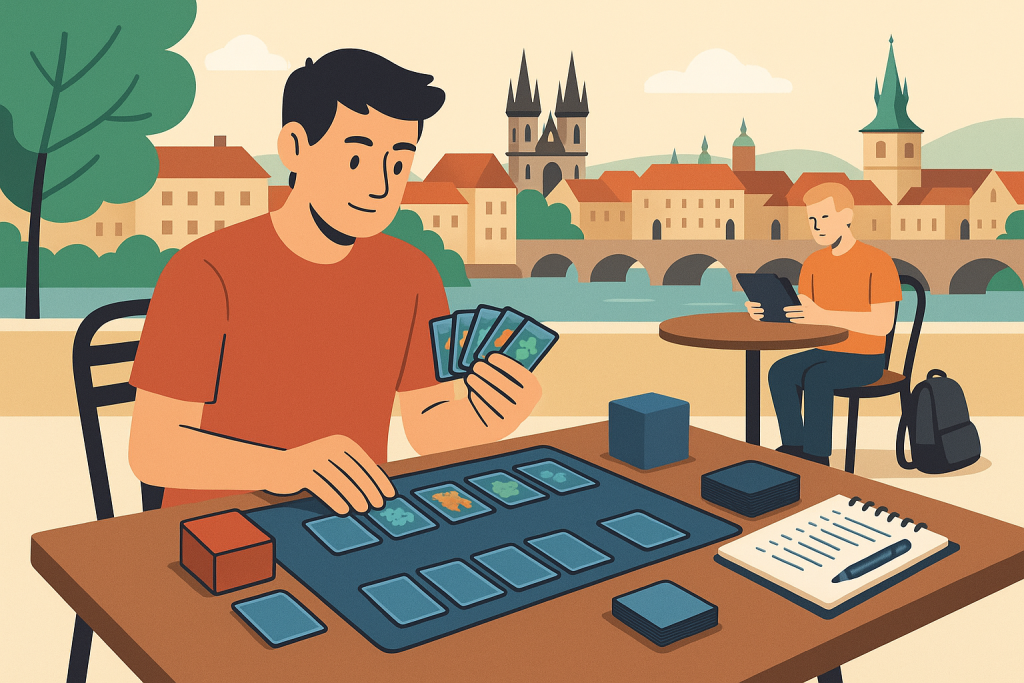
What to do: Estimate the field in percentages, then allocate list space according to frequency and prize impact. Separate matchups into four buckets: favorable and common, favorable and rare, unfavorable and common, unfavorable and rare.
For whom: Players entering events with published results, recent online tournament data, or a visible local testing group trend.
When not to use: Very small events where pairings are too random and one local rogue deck dominates attendance.
Prioritize common matchups first
If a deck is 55-45 into three popular archetypes and 35-65 into one fringe archetype, list space should usually support the common pairings. Tournament equity comes from round frequency. Overreacting to a low-share threat often produces a weaker overall record.
A useful rule: every flex slot should justify itself in one of three ways:
- It improves a high-share matchup.
- It fixes a structural consistency problem.
- It creates a stronger prize map across multiple pairings.
If a card does none of those, it is likely just comfort tech.
Create a matchup matrix before finalizing 60 cards
Use a one-page chart with columns for expected share, game-one plan, post-adjustment plan, key opposing threats, and whether the matchup is won by speed, disruption, or prize denial. This forces decisions that can be tested objectively.
Example matrix categories:
- Fast two-prize decks: prioritize tempo, gust timing, and bench protection.
- Single-prize or spread decks: prioritize recovery and efficient multi-turn prize trades.
- Control or denial variants: prioritize resource conservation and non-obvious win conditions.
- Mirror: prioritize opening consistency, first relevant attack, and gust sequencing.
The result is better than saying a matchup “feels close.” A matrix produces targeted testing questions such as: “Does the fourth switching card improve the mirror more than the extra recovery slot helps spread?”
Turn matchup notes into a real game plan for best-of-three play
What to do: Write a one-paragraph plan for each major archetype covering opening priorities, midgame pivot points, and endgame prize route. Include what to bench, what to avoid benching, and which resources must not be discarded early.
For whom: Players who already know their deck mechanically but lose percentage points to sequencing or unclear priorities in long rounds.
When not to use: Brand-new players still learning core rules, where too much pre-written planning can overwhelm basic execution.
Focus notes on decision points, not card text
Good matchup notes do not restate what cards do. They answer:
- What is the preferred first attack and by which turn?
- Which opposing threat must be removed immediately, and which can be ignored?
- Is the matchup about taking the first two prizes, equalizing tempo, or forcing a delayed final prize turn?
- Which bench spots are safe, and which create liability to gust or spread?
- What is the fallback line when key pieces are prized?
That level of specificity reduces slow play against the clock and lowers the chance of drifting into the opponent’s preferred pace.
Plan differently for game one and tied late rounds
In best-of-three, the highest-value line may change with time remaining. A deck that is slightly favored in a long game may need to adopt a faster, lower-ceiling line when 12 minutes remain in game three. Competitive Pokemon TCG rewards players who prepare for that shift before the event.
Practical example:
- Early round clock: choose the line with highest overall win rate, even if it takes longer.
- Late game three with little time: choose the line that preserves a path to a completed win, not merely a stronger board.
This is not about rushing. It is about recognizing when matchup plans must account for tournament structure as well as board state.
Prize mapping should start before the first knockout
What to do: Define the most likely six-prize route during setup, then revise it as prizes, benching patterns, and resource losses become visible. Track whether the game is a 2-2-2, 2-2-1-1, 3-2-1, or attrition-style map.
For whom: Intermediate and advanced players who know their list but want cleaner endgames and fewer missed gust opportunities.
When not to use: Never skip prize mapping entirely, but avoid overcommitting to one route when the opponent’s list is unknown or clearly off-standard.
Count prizes by attack efficiency, not by damage fantasy
The best prize map is usually the one that uses the fewest specific pieces. If taking two two-prizers requires multiple modifiers and exposed support Pokemon, while taking four smaller prizes needs only stable attacks and one gust effect, the lower-variance route is often superior.
Prize mapping questions to answer early:
- How many attacks are needed to win under average draws?
- Which knockout requires gust, damage boost, or stadium control?
- Can the opponent deny the map by limiting bench targets?
- Does taking an early easy prize expose the board to a stronger return knockout?
Account for your opponent’s prize map too
A strong map is not just “how to take six prizes.” It is “how to take six while making the opponent’s route awkward.” That can mean denying a two-prize bench target, delaying evolution on a vulnerable support Pokemon, or promoting a lower-value attacker after a knockout.
In many top-table games, the winning sequence comes from forcing the opponent into a seven- or eight-prize workload in practical terms, even though the rules still say six. Extra attacks created by healing, awkward benching, or forced gust turns change the entire race.
Tech cards should solve specific patterns, not broad anxiety
What to do: Add a tech only after identifying the exact board state it improves and testing whether that state occurs often enough to justify the slot.
For whom: Players refining a list from “good” to “event-ready,” especially in established metagames.
When not to use: Early in testing, before the core 56-58 cards are stable.
Ask four questions before including any tech
- Which matchup does it improve?
- At what turn window does it matter?
- What card is cut for it, and what consistency cost follows?
- Does it change the prize map or only create a low-frequency out?
If the answer to the fourth question is weak, the tech often belongs in a side note, not the final list.
Examples of justified tech logic in Pokemon TCG include:
- A card that converts an unfavorable common matchup from unwinnable to manageable.
- A recovery option that also improves mirror and spread pairings.
- A searchable one-of that does not reduce opening stability because it fits naturally into the deck’s engine.
Examples of weak tech logic include:
- Adding a card only because it looked strong in one streamed game.
- Solving a fringe rogue pairing at the cost of starter density.
- Including a situational answer that is poor when drawn early and unnecessary when ahead.
Testing should produce numbers, patterns, and keep-or-cut decisions
What to do: Split testing into three phases: solitaire consistency checks, focused matchup sets, and tournament simulation. Record opening success rates, dead-card frequency, average attack timing, and how games are actually won or lost.
For whom: Players with limited preparation time who need efficient feedback rather than endless ladder volume.
When not to use: Never rely on random online games alone if the goal is a serious event finish.
Use targeted test blocks
A productive session is not 20 untracked games. It is usually blocks such as:
- 10 opening-hand tests for setup consistency.
- 10 games into one key archetype from both play and draw.
- 5 games starting from a recreated difficult board state.
- One full best-of-three set with a round timer.
This reveals whether losses come from list construction, sequencing, or unrealistic expectations about the matchup.
Track meaningful metrics
Useful metrics include:
- Percent of games with a functional turn-one setup.
- Percent of games attacking by the target turn.
- Frequency of prized critical pieces affecting the main line.
- Number of turns where recovery was needed but unavailable.
- Win rate after early disruption.
These numbers make cuts easier. If a card rarely changes outcomes across 30-40 relevant games, it is often the first place to reclaim consistency space.
Prepare a tournament routine that protects decision quality late in the day
What to do: Build a repeatable pre-event and between-round routine covering deck check readiness, supplies, food, hydration, note review, and emotional reset after wins or losses.
For whom: Anyone playing a long in-person event where mental endurance matters as much as technical play.
When not to use: This matters even at smaller events, but strict routines can be simplified for short local tournaments.
Pre-event checklist
- Final decklist locked the night before.
- Sleeves checked for wear and replaced if uneven.
- Dice, markers, mat, and legal randomizer packed.
- Printed or digital matchup notes condensed to one page.
- Food chosen for steady energy rather than heavy meals.
- Travel and registration timing set with margin for delays.
Last-minute card changes are one of the highest-frequency avoidable mistakes. A stable list with clear plans usually outperforms a speculative late swap made without enough reps.
Between-round routine
Keep it short and consistent:
- Record result and one sentence about why the game was won or lost.
- Reset sleeves, board accessories, and prize markers.
- Drink water and eat a small snack when possible.
- Review only the next likely matchup notes, not the entire metagame.
- Drop the previous round emotionally before pairings are posted.
This routine is especially valuable after a frustrating loss. Tilt in Pokemon TCG often shows up as poor bench discipline, rushed search choices, and missed prize checks in the next round rather than obvious misplays.
Practical tournament scenarios and what to do
Scenario 1: A key setup piece is prized in a fast matchup
What to do: Immediately switch from the ideal prize map to the lowest-resource route. Avoid searching as if the prized card is available. Take the most efficient early prize if it preserves board stability, even if it lowers maximum ceiling.
For whom: Decks dependent on a narrow setup chain or single recovery pivot.
When not to use: If the prized piece can be accessed quickly through natural prize taking, do not abandon the main plan too early.
Scenario 2: The opponent benches no easy two-prize targets
What to do: Recalculate the map around forced gust turns, spread math, or a longer exchange of one-prize attackers. Preserve gust effects until they convert directly into a lead or game-ending checkmate.
Result: Fewer wasted boss effects and cleaner late-game finish windows.
Scenario 3: Game three starts with limited time remaining
What to do: Identify whether the matchup can still finish naturally. If not, prioritize lines that create a real path to a completed win within the clock, such as aggressive early pressure or a simpler two-knockout route. Avoid overbuilding a board that never gets time to attack.
When not to use: Do not force reckless all-in lines when the deck naturally closes games quickly and enough time remains.
Common limitations in Pokemon TCG tournament prep
No preparation method removes variance. Prize cards, matchup spread, coin flips, unknown techs, and pairings still influence results. A strong process raises baseline performance, but it does not guarantee conversion in every event.
There are also practical limits to over-planning:
- Metagames move quickly. Data from one weekend can age fast after a major event.
- Testing groups can create echo chambers. Repeatedly practicing the same local builds can misrepresent real tournament fields.
- Matchup notes can become too rigid. Opponents with unusual counts or sequencing may require abandoning the pre-written plan.
- Technical play still matters more than spreadsheets. Good prep cannot rescue repeated in-game sequencing errors.
The right balance is structured preparation with enough flexibility to react to the actual table.
FAQ
How many tech cards should a competitive Pokemon TCG deck run?
Usually as few as needed after the core game plan is fully stable. Many strong tournament lists are mostly engine and primary strategy, with only a small number of true flex slots.
How should matchup notes be organized before an event?
Keep them short. One page is usually enough: opening priority, what not to bench, key opposing threat, required resources to save, and preferred prize map.
What is the biggest deckbuilding mistake before a major tournament?
Cutting consistency for speculative matchup cards. Free losses from poor setup are more common than losses caused by not drawing a niche tech.
How often should prize mapping be updated during a game?
At setup, after the first two prizes, after any major gust or knockout swing, and whenever a key resource is discarded, prized, or recovered.
Is online ladder testing enough for Regional-level prep?
No. Ladder games help with repetitions, but serious prep should also include tracked sets into expected archetypes and best-of-three testing with a timer.
Conclusion
Competitive Pokemon TCG preparation for 2026 should revolve around a simple standard: every card, note, and routine should improve actual tournament win rate. That means building from role counts, respecting metagame share, writing matchup plans around decision points, and prize mapping from the opening turns instead of after the board becomes obvious.
The best-prepared players are rarely the ones with the most surprising lists. More often, they are the ones whose 60 cards open smoothly, whose matchup notes are short and actionable, and whose event routine protects focus in round one and round nine alike. In the Pokemon card game competitive ecosystem, disciplined preparation is not separate from gameplay. It is one of the strongest edges available.
Links in this article
Illustration image sources
Illustration images were generated with OpenAI Images API using neutral non-branded prompts.